
How You Relate to Anything Is How You Relate to Everything: Reclaiming the Spirit of the Christmas Tree

Because life is a cosmos of connection, because to be alive is to be in relationship with the world, because (in the immortal words of John Muir) “when we try to pick out anything by itself, we find it hitched to everything else in the universe,” how we relate to anything is how we relate to everything. There is always a choice in the way we orient to any object of attention — a person, a practice, a song, a stone: the choice to consecrate or commodify the object, to routinize or ritualize the relationship.
Take the Christmas tree. Rooted in pagan solstice rituals that made the evergreen a symbol and a celebration of resilience and eternal life, the modern Christmas tree originated in present-day Germany, around the time Kepler was formulating the laws of planetary motion while defending his mother in a witchcraft trial — that liminal epoch between the age of superstition and the age of science, which, like all transitional times, confused humanity’s ability to understand itself and its place in the universe. In such times, the ready-made answers fall apart and reality itself becomes an arena for power struggles. The Catholic church began splintering along the fault lines of conflicting ideologies, hurling the Western world into endless religious wars. With the need to reaffirm the foundational biblical myths, the naked Christmas tree emerged as an analogue of the tree anchoring Adam and Eve’s story.

It was Martin Luther who, with his genius for selling salvation that powered the Protestant Reformation, dressed the tree in the symbology of the immortal soul — legend has it that a walk through a starlit forest inspired him to adorn the Christmas tree with lights to symbolize the stars, thought to be immortal. (We would eventually lean on Kepler’s science to realize that we are only alive because stars die.)
Suddenly, here was something people could take into their homes to keep their faith and light up their harsh winter nights with the warmth of belonging, their war-torn lives with the promise of immortality.
But it took another quarter millennium and the birth of mass media for the Christmas tree to leave the religious realm and colonize secular life: In 1848, an engraving of the young Queen Victoria and her German cousband Albert appeared in The Illustrated London News — the world’s first illustrated weekly magazine — depicting the royal couple delighting in a lavishly decorated Christmas tree.

The image went, as it were, viral — papers across the British Empire reprinted it, sparking a craze for the bedazzled conifer, making it an emblem of the two things human nature most yearns for: love and power. Within a century, capitalism — the religion of our epoch, predicated on packaging our yearnings and selling them back to us at the price of the product — had made of the Christmas tree a commodity, grown like industrial corn and disposed of as garbage.
So here we find ourselves facing that choice of how to relate to the Christmas tree, nested within which is the choice of how to relate to our lives in this world we have not chosen for ourselves but must live in — the choice in which lie our power and our freedom. To find in this commodity the vestige of something ancient and true is to reclaim love as the counterweight to consumerism and the meaning of our mortality.
That is what Brian Doyle — who wrote so movingly about how to live a miraculous life just before death took him at the peak of his powers — invites in a short, splendid piece titled “Muttered Prayer in Thanks for the Under-Genius of Christmas,” part of his altogether wonderful Book of Uncommon Prayer: 100 Celebrations of the Miracle & Muddle of the Ordinary (public library). He writes:
Putting up ye old fir tree last night, and pondering why again we slay a perfectly healthy tree ten years of age, not even a teenager yet, and prop up the body, and drape it with frippery… I saw the quiet pleasure of ritual, the actual no-kidding no-fooling urge to pause and think about other people and their joy, the anticipation of days spent laughing and shouldering in the kitchen, with no agenda and no press of duty. I saw the flash of peace and love under all the shrill selling and tinny theater; and I was thrilled and moved. And then I remembered too that the ostensible reason for it all was the Love being bold and brave enough to assume a form that would bleed and break and despair and die; and I was again moved, and abashed; and I finished untangling the epic knot of lights, shivering yet again with happiness that we were given such a sweet terrible knot of a world to untangle, as best we can, with bumbling love. And so: amen.

This “bumbling love” that consecrates the commodified ritual is, in the end, what consecrates any relation, what returns us to the original responsibility of being alive — something Doyle addresses in another of his “uncommon prayers,” aimed at the Catholic Church and its “thirst for control and rules and power and money rather than the one simple thing the founder insisted on.” Centuries and civilizations after Rumi versed the art of choosing love over not-love, Doyle writes:
Granted, it’s a tough assignment, the original assignment. I get that. Love — Lord help us, could we not have been assigned something easier, like astrophysics or quantum mechanics? But no — love those you cannot love. Love those who are poor and broken and fouled and dirty and sick with sores. Love those who wish to strike you on both cheeks. Love the blowhard, the pompous ass, the arrogant liar. Find the Christ in each heart, even those. Preach the Gospel and only if necessary talk about it. Be the Word. It is easy to advise and pronounce and counsel and suggest and lecture; it is not so easy to do what must be done without sometimes shrieking. Bring love like a bright weapon against the dark… And so: amen.
This way of relating is, of course, a countercultural act of resistance, evocative of Leonard Cohen’s antidote to anger and of Walt Whitman’s instruction for life — resistance to cynicism and all the other species of despair, resistance to the power struggles that fray the cosmos of connection, resistance to anything and anyone who has forgotten and is trying to make us forget that the secret of life is simply to love anyway.
donating = loving
For seventeen years, I have been spending hundreds of hours and thousands of dollars each month composing The Marginalian (which bore the outgrown name Brain Pickings for its first fifteen years). It has remained free and ad-free and alive thanks to patronage from readers. I have no staff, no interns, no assistant — a thoroughly one-woman labor of love that is also my life and my livelihood. If this labor makes your own life more livable in any way, please consider lending a helping hand with a donation. Your support makes all the difference.
newsletter
The Marginalian has a free weekly newsletter. It comes out on Sundays and offers the week’s most inspiring reading. Here’s what to expect. Like? Sign up.
Source: The Marginalian | 21 Dec 2024 | 7:23 am(NZT)
Favorite Books of the Year: Art, Science, Poetry, Psychology, Children’s, and More

Because I read for the same reason I write — to fathom my life and deepen my living — looking back on a year of life has always been looking back on a year of reading. This year was different — a time of such profound pain and profound transformation that it fused reading and writing into a single, surprising act of the unconscious: I began making bird divinations to clarify the confusion of living and refill my reservoir of trust in the cohesion of the world. This daily practice left a great deal less time for other reading, especially anything new: The written word today seems more and more resigned to commodified virtue signaling and hollow self-help, so I found myself returning more and more to trusted treasures that have stood the test of time and changing moral fashions. Of the few new books I did read, these are the ones I will keep returning to for substance and succor in the years ahead.
MARIE HOWE: NEW AND SELECTED POEMS

Here is my favorite poem from it (which is also one of my favorite poems of all time), and here is another.
SOMETHING IN THE WOODS LOVES YOU

Here is a taste.
THANK YOU, EVERYTHING

Here is a taste.
OLIVER SACKS: LETTERS

Here is a taste.
WEATHERING

Here is a taste.
JUNG VS. BORG

Here is a taste.
THE OTHER SIGNIFICANT OTHERS

Here is a taste.
CONSOLATIONS II

Here is a taste.
THE WORK OF ART

Here is a taste.
WE ARE FREE TO CHANGE THE WORLD

Here is a taste.
SOMETHING ABOUT THE SKY

Here is a taste.
FLOWERS FOR THINGS I DON’T KNOW HOW TO SAY

Here is a taste.
ON GIVING UP

Here is a taste.
THE LIGHT EATERS

Here is a taste.
KAMAU & ZUZU FIND A WAY

Here is a taste.
LIFE AS NO ONE KNOWS IT

Here is a taste.
THERE’S A GHOST IN THE GARDEN

Here is a taste.
CLOUDSPOTTING FOR BEGINNERS

Here is a taste.
WE GO TO THE PARK

Here is a taste.
THE MIRACULOUS FROM THE MATERIAL

Here is a taste.
THE MESSAGE

THE ART OF CRYING

Here is a taste.
THE DICTIONARY STORY

Here is a taste.
(AND ONE I MADE)

Peek inside here.
(AND ONE COMING NEXT YEAR)

Peek inside here.
donating = loving
For seventeen years, I have been spending hundreds of hours and thousands of dollars each month composing The Marginalian (which bore the outgrown name Brain Pickings for its first fifteen years). It has remained free and ad-free and alive thanks to patronage from readers. I have no staff, no interns, no assistant — a thoroughly one-woman labor of love that is also my life and my livelihood. If this labor makes your own life more livable in any way, please consider lending a helping hand with a donation. Your support makes all the difference.
newsletter
The Marginalian has a free weekly newsletter. It comes out on Sundays and offers the week’s most inspiring reading. Here’s what to expect. Like? Sign up.
Source: The Marginalian | 18 Dec 2024 | 3:50 am(NZT)
How to Have Enough: Wendell Berry on Creativity and Love

“Enough is so vast a sweetness, I suppose it never occurs, only pathetic counterfeits,” Emily Dickinson sighed in one of her love letters to Susan an epoch before Kurt Vonnegut, in a short and lovely poem, distilled happiness to the knowledge that you have enough. It is not an easy knowledge to live with amid the commodified counterfeits of happiness that light up these sunset days of Western civilization, with its mesmerism of maximums and its cult of more, materially and spiritually — capitalism goads us to do more in order to own more while the secular church of self-improvement goads us to be more in order to do more.
Against this backdrop, to take a sabbath is a radical act, an act of countercultural act of courage and resistance, none more radical than a sabbath taken in nature — that eternal pasture of enoughness, which knew from the outset to create just enough more matter than antimatter for the first small seed of something to bloom into everything; which knows daily to make everything, from the electron to the elephant, take up just as much space and energy as it needs to be exactly what it is; which made every life finite and set a limit even to the speed of light.
To be in nature, without doing, is to be reminded that we are nature, too; that we cannot force the creative force that made us; that we need not keep breaking our own hearts on expectation’s cold hard edge of not-enough.

The poet, farmer, and wise elder Wendell Berry, who once defined wisdom as “the art of minimums,” takes up these immense and intimate questions throughout his wonderful collection This Day (public library) — his series of sabbath poems composed between 1979 and 2013, celebrating the sabbath as a “rich and demanding” idea that “gains in meaning as it is brought out-of-doors and into a place where nature’s principles of self-sustaining wholeness and health are still evident,” a place where “the natural and the supernatural, the heavenly and the earthly, the soul and the body, the wondrous and the ordinary, all appear to occur together in the one fabric of creation.”
In the preface, Berry considers how nature calibrates expectation — even in the creative act itself, where inspiration is not a reach for more but a letting be of what is, a surrender to reality, which is miracle enough:
On Sunday mornings I often attend a church in which I sometimes sat with my grandfather, in which I sometimes sit with my grandchildren, and in which my wife plays the piano. But I am a bad-weather churchgoer. When the weather is good, sometimes when it is only tolerable, I am drawn to the woods on the local hillsides or along the streams… In such places, on the best of these sabbath days, I experience a lovely freedom from expectations — other people’s and also my own. I go free from the tasks and intentions of my workdays, and so my mind becomes hospitable to unintended thoughts: to what I am very willing to call inspiration. The poems come incidentally or they do not come at all. If the Muse leaves me alone, I leave her alone. To be quiet, even wordless, in a good place is a better gift than poetry.
In how it thrives on the freedom from expectation, in how it demands a total surrender and breaks the moment it is demanded of, creativity has a lot in common with love. It may be that nature invented love to teach us the art of enoughness — to learn how to open the heart to another without condition or expectation, to be fully welcomed in another heart in order to learn the hardest axiom of being: that we are, and always were, enough.

Love’s salutary alchemy of enoughness comes alive in the second part of Berry’s eight-part sabbath poem of 1994:
Finally will it not be enough,
after much living, after
much love, after much dying
of those you have loved,
to sit on the porch near sundown
with your eyes simply open,
watching the wind shape the clouds
into the shapes of clouds?Even then you will remember
the history of love, shaped
in the shapes of flesh, ever-changing
as the clouds that pass, the blessed
yearning of the body for body,
unending light. You will remember, watching
the clouds, the future of love.
Couple with John J. Plenty and Fiddler Dan — a lovely vintage illustrated fable about the meaning and measure of enough — then revisit this soulful animated adaptation of Berry’s poem “The Peace of Wild Things” and his prose meditation on the nature of the universe lensed through a sunflower.
donating = loving
For seventeen years, I have been spending hundreds of hours and thousands of dollars each month composing The Marginalian (which bore the outgrown name Brain Pickings for its first fifteen years). It has remained free and ad-free and alive thanks to patronage from readers. I have no staff, no interns, no assistant — a thoroughly one-woman labor of love that is also my life and my livelihood. If this labor makes your own life more livable in any way, please consider lending a helping hand with a donation. Your support makes all the difference.
newsletter
The Marginalian has a free weekly newsletter. It comes out on Sundays and offers the week’s most inspiring reading. Here’s what to expect. Like? Sign up.
Source: The Marginalian | 15 Dec 2024 | 9:36 am(NZT)


Thank You, Everything: An Illustrated Love Letter to the World

We forget that none of this had to exist — that we weren’t owed mountains and music by the universe. And maybe we have to forget — or we would be too stupefied with gratitude for every raindrop and every eyelash to get through the daily tasks punctuating the unbidden wonder of our lives. But it is good, every once in a while, to let ourselves be stupefied by gratitude, to cast upon ourselves a spell against indifference by moving through the world with an inner bow at every littlest thing that prevailed over the odds of otherwise in order to exist.
Artist couple Mayumi Otero and Raphael Urwiller, who work together under the pen name Icinori, offer a vibrant invitation to this countercultural way of seeing in Thank You, Everything (public library) — a meditative yet exuberant journey through the world within and the world without, inspired by the Japanese notion of tsuumogami: the soul, or spirit, that inanimate objects are believed to acquire after being of service in the world for a hundred years.
Out of what begins as an impressionistic portrait of gladness — “thank you, blue”; “thank you, morning”; “thank you, glass” — emerges a story syncopating the abstract and the concrete.


Day breaks with gratitude, breaks into a mysterious adventure, each step of which is a bow — we see the protagonist move through cities and landscapes, thanking every large and little thing along the way: bicycle and bus and airplane, sky and clouds and streams, night and fog, binoculars and birds, caterpillar and leaf, spring and silence.


The destination, rather than a place, is a state of being — the recompense of paying everything in our path the gratitude and reverence it is due for merely existing. For we forget, too, that dignity — this deepest reverence for being — is not something we can ever have for ourselves unless we accord it to everything and everyone else.


Couple Thank You, Everything with Oliver Sacks on gratitude and the measure of living at the horizon of death, then revisit poet Marissa Davis’s love letter to everything alive.
Illustrations courtesy of Enchanted Lion Books; photographs by Maria Popova
donating = loving
For seventeen years, I have been spending hundreds of hours and thousands of dollars each month composing The Marginalian (which bore the outgrown name Brain Pickings for its first fifteen years). It has remained free and ad-free and alive thanks to patronage from readers. I have no staff, no interns, no assistant — a thoroughly one-woman labor of love that is also my life and my livelihood. If this labor makes your own life more livable in any way, please consider lending a helping hand with a donation. Your support makes all the difference.
newsletter
The Marginalian has a free weekly newsletter. It comes out on Sundays and offers the week’s most inspiring reading. Here’s what to expect. Like? Sign up.
Source: The Marginalian | 13 Dec 2024 | 12:15 pm(NZT)
Something in You Hungers for Clarity: Ta-Nehisi Coates on Writing and the Power of Words to Remake the World

“Words have more power than any one can guess; it is by words that the world’s great fight, now in these civilized times, is carried on,” Mary Shelley wrote in the middle of the Napoleonic Wars that laid the template for the colonialist power structure of the modern world, in an era when her chromosomes denied her the authority of her natural powers.
Who gets to write shapes what gets to be written, which shapes what is remembered — that is the making of the collective selective memory we call history, and it is made of words. We invented words to name the world and invented power to apportion the named. It is our inventions that tell the fullest story of our nature. The range of them — the range between chocolate and racism, between the Benedictus and the bomb — is the measure of what James Baldwin called “the doom and glory” of what we are, metered by the words that tell the story of our self-creation.

“What I have always wanted is to expand the frame of humanity, to shift the brackets of images and ideas,” Ta-Nehisi Coates reflects in The Message (public library) — his soulful and sobering reckoning with the power of words and the power structures roiling beneath the landscape of permission for making the images and ideas we call art. What emerges is a manifesto for reexamining who gets to word the world’s story and render human the worlds within the world, pulsating with the urgency of the writer’s job to clarify in order to galvanize — for “you cannot act upon what you cannot see.”
Writing, Coates recalls, was one of the great “obsessions” of his childhood — he relished the “private ecstasy” found in “the organization of words, silences, and sound into stories,” in “the employment of particular verbs, the playful placement of punctuation,” this mysterious alchemy of skill and vision with the power to “make the abstract and distant into something tangible and felt,” to dismantle the myths told by the wardens of the status quo and tell a different story about the world and its horizons of possibility. An epoch after John Steinbeck insisted in his Nobel Prize acceptance speech that a writer ought to bear the torchlight of clarity in humanity’s “gray and desolate time of confusion,” Coates considers what it takes to do that, in all its ecstasy and power:
There has to be something in you, something that hungers for clarity. And you will need that hunger, because if you follow that path, soon enough you will find yourself confronting not just their myths, not just their stories, but your own.

Permeating the book is Coates’s countercultural courage not to mistake for reality what he so aptly terms “the haze” of his own experience — a needed reminder that we lens everything before us through everything behind us and bow to the image in the lens, calling it the world. And yet what the visionary physicist John Archibald Wheeler wrote of the nature of reality — “this is a participatory universe [and] observer-participancy gives rise to information” — is true of the nature of writing. Coates reflects:
There are dimensions in your words — rhythm, content, shape, feeling. And so too with the world outside. The accretion of imperfect, discomfiting life must be seen and felt so that the space in your mind, gray, automatic, and square, fills with angle, color, and curve… But the color is not just in the physical world you observe but in the unique interaction between that world and your consciousness — in your interpretation, your subjectivity, the things you notice in yourself.
Just as the writer writes with all of themselves, the reader reads with all of themselves, adding another layer of subjectivity in the act of interpretation. Sylvia Plath understood this when she was only a teenager: “Once a poem is made available to the public, the right of interpretation belongs to the reader.” So too with all creative work, much as a child enters the world to become their own person. “Your children are not your children,” Kahlil Gibran wrote in one of his most poignant poems. “They come through you but not from you.” Echoing Plath and Gibran, Coates reflects on his own writing:
I imagine my books to be my children, each with its own profile and way of walking through the world… It helps me remember that though they are made by me, they are not ultimately mine. They leave home, travel, have their own relationships, and leave their own impressions. I’ve learned it’s best to, as much as possible, stay out of the way and let them live their own lives.

This is not, however, a recusal from responsibility — over and over, Coates celebrates, demands even, the power of the written word to change the life of the world and the course of what will one day be history by changing the present landscape of possibility and permission we call politics. He writes:
History is not inert but contains within it a story that implicates or justifies political order… A political order is premised not just on who can vote but on what they can vote for, which is to say on what can be imagined. And our political imagination is rooted in our history, our culture, and our myths.
[…]
Politics is the art of the possible, but art creates the possible of politics… Novels, memoirs, paintings, sculptures, statues, monuments, films, miniseries, advertisements, and journalism all order our reality.
Half a century after Gwendolyn Brooks wrote in her forgotten poem “Book Power” that “books feed and cure and chortle and collide,” that they are “flame and flight and flower,” Coates considers the singular power of writing among the other tendrils of the creative spirit — the power of revelation and self-revelation:
Film, music, the theater — all can be experienced amidst the whooping, clapping, and cheering of the crowd. But books work when no one else is looking, mind-melding author and audience, forging an imagined world that only the reader can see. Their power is so intimate, so insidious, that even its authors don’t always comprehend it.
Complement these fragments of The Message with James Baldwin’s advice on writing and some excellent tips from Mary Oliver, then revisit May Sarton on how to cultivate your talent.
donating = loving
For seventeen years, I have been spending hundreds of hours and thousands of dollars each month composing The Marginalian (which bore the outgrown name Brain Pickings for its first fifteen years). It has remained free and ad-free and alive thanks to patronage from readers. I have no staff, no interns, no assistant — a thoroughly one-woman labor of love that is also my life and my livelihood. If this labor makes your own life more livable in any way, please consider lending a helping hand with a donation. Your support makes all the difference.
newsletter
The Marginalian has a free weekly newsletter. It comes out on Sundays and offers the week’s most inspiring reading. Here’s what to expect. Like? Sign up.
Source: The Marginalian | 12 Dec 2024 | 6:53 am(NZT)

A Heron’s Antidote to Fear of Death
They didn’t imagine it, the dying dinosaurs, that they would grow wings and become birds, become the laboratory in which evolution invented dreams and the cathedral in which it invented faith.
“There is grandeur in this view of life,” Darwin consoled himself as his beloved daughter was dying, for he knew that death is the engine of life, that across the history of natural selection the death of the individual is what ensured the adaptation and survival of the species. And yet against this natural grandeur, we suffer the smallness of our imagination about death, as about the myriad small deaths punctuating life — the losses, the endings, the falterings of hope — forgetting somehow that every ending is a beginning in retrograde, that what may seem like a terminus may be a transformation.

These are the thoughts thinking themselves through me as I watch a great white heron rising from the water’s edge, from this boundary line between worlds, this lapping memory of how life emerged from non-life.
Because my bird divinations began with its great blue cousin, I cannot help but ask the majestic white bird for a message.
Combing the eleven pages of Audubon’s ornithological text about the species, I follow the usual process and let the words rearrange themselves into this koan from the unconscious:

Working on this divination, I was reminded of a long-ago counterpart — one of Mary Oliver’s least known poems, found in her 2003 collection What Do We Know (public library) and read here by 19-year-old poet, artist, and heron-lover Rose Hanzlik to the sound of Debussy’s “Reverie.”
HERON RISES FROM THE DARK, SUMMER POND
by Mary OliverSo heavy
is the long-necked, long-bodied heron,
always it is a surprise
when her smoke-colored wingsopen
and she turns
from the thick water,
from the black sticksof the summer pond,
and slowly
rises into the air
and is gone.Then, not for the first or the last time,
I take the deep breath
of happiness, and I think
how unlikely it isthat death is a hole in the ground,
how improbable
that ascension is not possible,
though everything seems so inert, so nailedback into itself —
the muskrat and his lumpy lodge,
the turtle,
the fallen gate.And especially it is wonderful
that the summers are long
and the ponds so dark and so many,
and therefore it isn’t a miraclebut the common thing,
this decision,
this trailing of the long legs in the water,
this opening up of the heavy bodyinto a new life: see how the sudden
gray-blue sheets of her wings
strive toward the wind; see how the clasp of nothing
takes her in.

Complement with the poetic science of what happens when we die and astronomer Rebecca Elson’s magnificent poem “Antidotes to Fear of Death,” then revisit the great blue heron as a lens on our search for meaning.
donating = loving
For seventeen years, I have been spending hundreds of hours and thousands of dollars each month composing The Marginalian (which bore the outgrown name Brain Pickings for its first fifteen years). It has remained free and ad-free and alive thanks to patronage from readers. I have no staff, no interns, no assistant — a thoroughly one-woman labor of love that is also my life and my livelihood. If this labor makes your own life more livable in any way, please consider lending a helping hand with a donation. Your support makes all the difference.
newsletter
The Marginalian has a free weekly newsletter. It comes out on Sundays and offers the week’s most inspiring reading. Here’s what to expect. Like? Sign up.
Source: The Marginalian | 7 Dec 2024 | 5:55 am(NZT)
The Wound Is the Gift: David Whyte on the Relationship Between Anxiety and Intimacy

It takes a long time to know a person — to unbutton the costume of personality and unlace the corset of coping mechanisms in order to touch the naked soul. It is a process delicate and difficult, riven by anxiety and absolutely terrifying to both, requiring therefore great courage and great vulnerability — a process the hard-won product of which we call intimacy. “There is no terror like that of being known,” Emerson anguished in his journal while trying to navigate his deep and complicated relationship with Margaret Fuller. It is a wise terror, for it knows that there is no greater pain than the pain of intimacy severed — by betrayal, by distance, by death. To triumph over that terror in order to know and be known on the level of the naked soul is an act of faith — perhaps the greatest act of faith there is. Because all faith requires a surrender to something we cannot control, all faith begins with the anguishing anxiety that prefaces the leap.
Poet and philosopher David Whyte explores the terrifying and transcendent work of intimacy in Consolations II — the second volume of his short, splendid essays, each reckoning with the deeper meaning of some ordinary and overused word to reveal its unexamined emotional etymology. In “Intimacy,” he writes:
Intimacy is presence magnified by our vulnerability, magnified by increasing proximity to the fear that underlies that vulnerability. Intimacy and the vulnerabilities of intimacy are our constant, invisible companions, yet companions who are always wishing to make themselves visible and touchable to us, always emerging from some deep interior, to ruffle and disturb the calm surface of our well apportioned lives. Intimacy is a living force, inviting me simultaneously from the inside as much as the outside. Something calling from within that wants to meet something calling in recognition from without. Intimacy is the art and practise of living from the inside out.
[…]
Our need and our fear of intimacy is felt through an ever present almost volcanic force emerging from some unknown origin inside us, exhibiting to all and sundry, our previously hidden unspoken desires, flowing out against all efforts to the contrary, through our unconscious and conscious behaviours.

And yet intimacy is haunted by a central paradox:
To become intimate is to become vulnerable not only to what I want and desire in my life, but to the fear I have of my desire being met.
This is the paradox of longing: Because longing can be an addiction, because no active addict ever wants to give up their addiction — or can without a great deal of suffering — it can be terrifying and almost unbearably vulnerable to surrender to an intimacy so amply fulfilling that it leaves nothing to long for. And yet in that vulnerability lies our power and our freedom to transform a relationship from a tether of dependency into a slender cord of grace.
David writes:
Intimacy cannot occur without a robust sense of vulnerability, and is tied to the sense of being pulled along in the gravitational field of any newly felt openness. In that new openness we feel as if we are pulled through the very doorway of our needs for something we desire deeply but cannot fully identify, partly because what we are about to identify is intimately connected with our own ability or inability to love.

Ultimately, he observes, intimacy is an instrument of discovery and self-discovery — a way of turning the walls between us and within us into sunlit windows through which to see and be seen:
Intimacy always carries the sense of something hidden about to be felt and known in surprising ways; something brought out and made visible, that previously could not be seen or understood. In intimacy what is hidden will become a gift, discovered and rediscovered again and again in the eyes of both giver and receiver.
[…]
To become human is to become visible, while carrying what is hidden as a gift to others.
Because what is visible is vulnerable, because what can be seen can be touched and what can be touched can be wounded, he adds:
Intimacy is intimately related to our sense of having been wounded, and the startling intuition that my way forward into life, or into another person’s life will be through the very doorway of the wound itself. Intimacy invites me to learn to trust the way being wounded has actually made me more available, more compassionate and possibly more intimate with the world, by being opened in ways I never realised it was possible to be open… Intimacy is always calibrated by the letting go of or the taking on of fear. Almost always our fear is experienced as an intimate invitation to understand and feel fully our particular form of wounded-ness.
[…]
Intimacy finds its ultimate expression in all the forms of surrender human beings find difficult to embrace.
The difficulty of that surrender almost always takes shape as anxiety — a word to which David devotes another of the book’s essays. Anxiety, he observes, is often an avoidance mechanism and a dissociation device — “a protection against real intimacy, real friendship and real engagement with our work,” a way not to feel “the full vulnerability of being visible and touchable in a difficult world.” In anxiety, we disallow ourselves “the ability to stop and rest and the spacious silence needed for… a new understanding” — and all true intimacy opens into a new understanding of ourselves, so that “we learn that what we thought we knew is not equal to what we are discovering… that who we thought we were is not who we are now.”
By allowing true intimacy on the smallest scale of personal love — the bond between one and one — we open into the largest scale of belonging, into cohesion with what Margaret Fuller, inspired by Goethe, called the All. David writes:
The need for intimacy in a human life and in a human social life is as foundational as our daily hunger and our never ending thirst, and needs to be met in just the same practical way, every day, just as necessarily and just as frequently: in touch, in conversation, in listening and in seeing, in the back and forth of ideas; intimate exchanges that say I am here and you are here and that by touching our bodies, our minds or our shared work in the world, we make a world together… Intimacy is our evolutionary inheritance, the internal force that has us returning to another and to the world from our insulated aloneness again and again, no matter our difficulties and no matter our wounds.
Couple these fragments of the thoroughly soul-slaking Consolations II — other essays in which explore such overused, underexamined words as shame, time, love, burnout, and end — with a wonderful read on lichens as a lens on intimacy, Kahlil Gibran on love’s difficult balance of intimacy and independence, and Eric Berne on the key to true intimacy, then savor this excellent interview with David by one of my oldest friends.
donating = loving
For seventeen years, I have been spending hundreds of hours and thousands of dollars each month composing The Marginalian (which bore the outgrown name Brain Pickings for its first fifteen years). It has remained free and ad-free and alive thanks to patronage from readers. I have no staff, no interns, no assistant — a thoroughly one-woman labor of love that is also my life and my livelihood. If this labor makes your own life more livable in any way, please consider lending a helping hand with a donation. Your support makes all the difference.
newsletter
The Marginalian has a free weekly newsletter. It comes out on Sundays and offers the week’s most inspiring reading. Here’s what to expect. Like? Sign up.
Source: The Marginalian | 4 Dec 2024 | 4:20 am(NZT)
The Cosmogony of You
We live in a state of perpetual dissociation from the almost unbearable wonder of being alive. Wonder is always an edge state, its edge so sharp it threatens to rupture the mundane and sever us from what we mistake for reality — the TV, the townhouse, the trauma narrative. If we fell asleep each night remembering “the singularity we once were” and awoke each morning with the bright awareness that every atom in our bodies can be traced to one of the first stars — a particular star in the infant universe that made this particular body to sinew this particular soul across billions and billions of blind steps each one of which could have gone otherwise — we would be too wonder-struck by the miraculousness of it all to deal with the mundane. But the dishes have to be washed and the emails have to be written, so we avert our eyes from the majesty and mystery of a universe that made them in order to look at itself, from the majesty and mystery of what we are.

Azita Ardakani offers a lyrical antidote to this self-expatriation from our cosmic inheritance in this breathtaking piece she has kindly let me publish on The Marginalian — part poem and part lullaby, part compact history of science and part creation myth, radiating the revelatory simplicity of a children’s book and the causal complexity of a cosmogony.
Azita writes:
Once upon a time,
In a place far far away,
The darkness drifted.
The darkness knew no time.
Reaching for infinity, only knowing beyond.
One day in the web of inky forever, it asked itself, can I see you?
It waited, and waited, and then, answered, a star.
And then another, and another, and, another.
Another was where it began,
and as the star beings asked to be born to meet the darkness from which they came, one particular planet created water so it too could reflect the stars back to themselves.
The stars seeing their reflection were filled with joy and delight.
Curiosity was born in their light millions of years away.
One by one they made their way down, to touch the ocean, to see themselves.
The soil darkness watched with awe as the stars arrived,
A heart’s desire asked: Can I see you closer?
The water stars stretched onto the soil, and mixed into the clay, and became,
everything.
Yes you too, coyote who hears this, wise owl, mouse and rabbit, you too sleeping fawn, you too tree and root and seed, you too nested flight, and you too, sitting two legged.
Mixed from clay and star, flesh and life, a hollow canal opened so breath too could reach back to the darkness.
Missing the beginning, it exhaled a bridge, home.
The star water became everything we know, and you? The story of us?
Well, to experience the closest thing to the very beginning of star meeting water, we learned to create a small ocean inside of us, where it could all be felt, all over again.
Once upon a time, in a place far far away, the darkness drifted, and you drifted inside it.
You were the wish you once wished for.

Complement with Pattiann Rogers’s stunning poem about how stardust became sapiens and the wondrous science of how stars begot souls, then revisit N.J. Berrill’s forgotten 1958 masterpiece You and the Universe and Hannah Emerson’s poem “Center of the Universe” — perhaps the best instruction I know on how to be alive.
donating = loving
For seventeen years, I have been spending hundreds of hours and thousands of dollars each month composing The Marginalian (which bore the outgrown name Brain Pickings for its first fifteen years). It has remained free and ad-free and alive thanks to patronage from readers. I have no staff, no interns, no assistant — a thoroughly one-woman labor of love that is also my life and my livelihood. If this labor makes your own life more livable in any way, please consider lending a helping hand with a donation. Your support makes all the difference.
newsletter
The Marginalian has a free weekly newsletter. It comes out on Sundays and offers the week’s most inspiring reading. Here’s what to expect. Like? Sign up.
Source: The Marginalian | 2 Dec 2024 | 3:59 am(NZT)
How to Love Yourself and How to Love Another: A Playful and Poignant Vintage Fable about Cherishing the Particular

The great problem of consciousness is that all it knows is itself, and only dimly. We can override this elemental self-reference only with constant vigilance, reminding ourselves again and again as we forget over and over how difficult it is — how nigh impossible — to know what it is like to be anybody else. It does not come naturally to us, this recognition that every other consciousness is a different operating system governed by different needs and different responses to the same situations, encoded by different formative experiences. This is why the Golden Rule, a version of which is appears in all major spiritual and ethical traditions, may be the most narcissistic of our moral codes, with its assumption that others want done unto them the same things we ourselves want. One measure of love — perhaps the greatest measure — may be the understanding that another’s needs, as incomprehensible as they may appear to us and as orthogonal to our own, are a fundamental part of who they are; that to love someone is to love whatever they need to be their fullest, truest self rather than a projection of who we imagine or desire them to be.
In 1963, two years before she composed her iconic ode to friendship, the prolific children’s book author, theologian, and novelist Sandol Stoddard (December 16, 1927–January 4, 2018) took up this fundamental challenge of connection in her playful and poignant book My Very Own Special Particular Private and Personal Cat (public library).

The story, illustrated with great vivacity and typographic virtuosity by artist, dancer, choreographer, and theater director Remy Charlip (January 10, 1929–August 14, 2012), begins with a boy declaring ownership of his cat, in that classic “MINE!” way that children have of feeling out the boundary between where they end and the rest of the world begins — a boundary we spend our lives trying to locate as ever-changing selves moving through an ever-changing world, trying to discern the contours of belonging.


“Come up on my lap and have a little nap,” the boy commands the cat, who looks in no mood for a nap on a lap. Page after page, we see the boy treat the cat as his plaything — dressing the cat in a sweater, putting the cat in a stroller, tucking the cat into a crib — until the forbearing cat finally has it and claws out the sweater, leaps from under the blanket, breaks out of the bed, breaking the bed.


With the fury of a dispossessed tyrant that so readily comes to children (and to the petulant child nested in every maturity), the boy roars an indignant declaration of ownership at the cat, who gently sings back the fundamental dignity of personhood.


In consonance with Alan Watt’s prescription for how to become who you truly are, in which he insisted that “Life and Reality are not things you can have for yourself unless you accord them to all others,” the cat’s outpouring of self-possession undams the boy’s own.


In the end, the boy discovers what we all must eventually, if we are to grow into the full bigness of the heart: that in every relationship of trust and tenderness, each is the guardian of the other’s particularity; that to love someone not for the comfort or compliance they can give you but for exactly who they are, the special and particular person, is the greatest, the only kind of love; that it is impossible to achieve this without first learning to love yourself for exactly who you are, with all the courage and vulnerability this requires — for, as e.e. cummings so memorably wrote, “to be nobody-but-yourself — in a world which is doing its best, night and day, to make you everybody else — means to fight the hardest battle which any human being can fight.” Or any cat can fight. The story ends with the companionable quietude of boy and cat coming to rest in their parallel particularities — that supreme measure of a healthy bond.


And, as another excellent writer wrote in another cat-story of what it means to be human: “You can never know anyone as completely as you want. But that’s okay, love is better.”
donating = loving
For seventeen years, I have been spending hundreds of hours and thousands of dollars each month composing The Marginalian (which bore the outgrown name Brain Pickings for its first fifteen years). It has remained free and ad-free and alive thanks to patronage from readers. I have no staff, no interns, no assistant — a thoroughly one-woman labor of love that is also my life and my livelihood. If this labor makes your own life more livable in any way, please consider lending a helping hand with a donation. Your support makes all the difference.
newsletter
The Marginalian has a free weekly newsletter. It comes out on Sundays and offers the week’s most inspiring reading. Here’s what to expect. Like? Sign up.
Source: The Marginalian | 30 Nov 2024 | 1:55 am(NZT)
Delight Between Science and Magic: Euler’s Disk and the Sound of the Singularity
One afternoon in the late 1980s, sitting in the company cafeteria, aerospace engineer Joseph Bendik found himself so bored that he took a coin out of his pocket and began spinning it atop the table. In a testament to the eternal paradox of boredom and wonder as two sides of the same coin — the currency of life that is attention — he was suddenly wonder-smitten by the exquisite elegance of the physics making the coin seem to levitate, spinning faster and faster rather than slower and slower before shuddering to a stop.
Here was a demonstration of laws undergirding everything from the motions of planets to the photosynthesis of plants — the conservation of angular momentum and the conservation of energy — a demonstration made not in equations but in sheer delight.
Bendik realized that if he toyed with a few variables — the smoothness of the surface, the mass of the spinning disk, the width of its edge — he could magnify the delight and make the science border on magic. And so he turned the mathematics — that most splendid plaything of the mind — into a toy: a heavy disk spinning into near-infinity atop a mirror surface.

He named it Euler’s Disk for Leonhard Euler, who had died two centuries earlier to be remembered by many as the greatest mathematician to ever live.
Along with a copy of The Universe in Verse and a baby lemon tree planted from a seed, Euler’s Disk may be my favorite gift to give, and the one most certain to bring unalloyed delight. Here is a gleeful demonstration of it by my former partner turned best friend upon receiving it:
This is how it works: Holding the disk upright on the mirror, you give it a hard manual spin that adds kinetic energy to its potential energy. Once in motion, the disk relies on its angular momentum to try to remain upright as gravity pulls it downward and the mirrored base exerts an upward counterforce. These opposing tugs make it spin faster and faster, appearing to levitate, its sound whirring at a higher and higher frequency as the disk’s points of contact with the mirror make a circle oscillating with a constant angular velocity.
If there were no friction, this motion would continue forever — the product of a power law modeling what is known as finite-time singularity. But the mirror, smooth though it is, still provides some friction. Coupled with resistance from the air — the same air drag central to the physics of how birds fly — it eventually causes the whirring disk to sigh to a sudden stop: the sound of the singularity.
Couple with the story of how Emmy Noether illuminated the conservation of energy (a story crowned with an Edna St. Vincent Millay poem), then revisit the poetic science of how cicadas sing — the sound of a living singularity.
donating = loving
For seventeen years, I have been spending hundreds of hours and thousands of dollars each month composing The Marginalian (which bore the outgrown name Brain Pickings for its first fifteen years). It has remained free and ad-free and alive thanks to patronage from readers. I have no staff, no interns, no assistant — a thoroughly one-woman labor of love that is also my life and my livelihood. If this labor makes your own life more livable in any way, please consider lending a helping hand with a donation. Your support makes all the difference.
newsletter
The Marginalian has a free weekly newsletter. It comes out on Sundays and offers the week’s most inspiring reading. Here’s what to expect. Like? Sign up.
Source: The Marginalian | 27 Nov 2024 | 7:24 am(NZT)
How to Live a Miraculous Life: Brian Doyle on Love, Humility, and the Quiet Grace of the Possible

Suppose we agree that we are here to love anyway — to love even though the work is almost unbearably difficult, even though we know that everything alive is dying, that everything beautiful is perishable, that everything we love will eventually be taken from us by one form of entropy or another, culminating with life itself. Suppose we agree that, as Rilke so passionately insisted, “for one human being to love another… is perhaps the most difficult of all our tasks, the ultimate, the last test and proof, the work for which all other work is but preparation.”
This, then, is the agreement: Learning to live is learning to love, and learning to love is learning to die — the imperative in the inevitable that renders our transience meaningful and holy. The price of this holiness is absolute humility: There is no pact to be made with the universe — we die, whether or not we agree to it, whether or not we have learned how to love in the bright interlude between atom and dust. We may or may not be lucky enough to live out the two billion heartbeats our creaturely inheritance has allotted us. But no matter how many we actually get, it matters how we spend them and what we spend them on. It may be the only thing that matters.
Not long before his untimely death by an aggressive brain tumor, Brian Doyle — who described himself as “a muddle and a conundrum shuffling slowly along the road, gaping in wonder, trying to just see and say what is” — took up these immense and eternal questions in what became his posthumous essay collection One Long River of Song: Notes on Wonder (public library).
Because the harshest realities of our own lives are often easiest to see and easiest to bear lensed through the lives of other creatures cushioned in symbol and metaphor — this is why we have fables and fairy tales — Doyle finds himself reckoning with mortality and the meaning of life as he examines the dead body of a Townsend’s mole (Scapanus townsendii) in his garden. Curious about the animal, he turns to the scientific literature and is suddenly disquieted by reading about the species as a lump-sum of data points. Overcome with tenderness for “this particular individual, and the flavor and tenor and yearning of this one life,” he writes:
This tribe of mole is thought to be largely solitary, I read, and I want to laugh and weep, as we are all largely solitary, and spend whole lifetimes digging tunnels toward each other, do we not? And sometimes we connect, thrilled and confused, sure and unsure at once, for a time, before the family cavern empties, or one among us does not come home at all, and faintly far away we hear the sound of the shovel.

Over and over, through the different winding paths of the different essays, Doyle returns to his animating ethos that “love is our greatest and hardest work” — nowhere more poignantly articulated than in an essay about the people seen leaping out of the Twin Towers hand in hand, their hands “nestled in each other with such extraordinary ordinary succinct ancient naked stunning perfect simple ferocious love.” He reflects on this harrowing and holy emblem of our deepest humanity:
Their hands reaching and joining are the most powerful prayer I can imagine, the most eloquent, the most graceful. It is everything that we are capable of against horror and loss and death. It is what makes me believe… that human beings have greatness and holiness within them like seeds that open only under great fires, to believe that some unimaginable essence of who we are persists past the dissolution of what we were, to believe against such evil hourly evidence that love is why we are here.
The trick, of course, is learning how to be here — how to remain fully present and filled with that ferocious love — knowing we will one day be gone, knowing it might be tomorrow. In what may be the most soulful and sensible advice on how to live an actualized life since Whitman’s, Doyle offers an anchor to that holy here:
You do your absolute best to find and hone and wield your divine gifts against the dark. You do your best to reach out tenderly to touch and elevate as many people as you can reach. You bring your naked love and defiant courage and salty grace to bear as much as you can, with all the attentiveness and humor you can muster. This life is after all a miracle and we ought to pay fierce attention every moment, as much as possible.
Paradoxically, this active and conscious effort is a heart that can only beat in the chest of surrender. Doyle adds the ultimate disclaimer:
You cannot control anything. You cannot order or command everything. You cannot fix and repair everything. You cannot protect your children from pain and loss and tragedy and illness. You cannot be sure that you will always be married, let alone happily married. You cannot be sure you will always be employed, or healthy, or relatively sane. All you can do is face the world with quiet grace and hope you make a sliver of difference.

At the center of this recognition is that most difficult triumph of unselfing for us creatures of self-importance: humility. In Doyle’s definition, humility is not a lowering down to the ground, as the word’s Latin root (humus) suggests, but a rising up and a reaching toward something we can never quite touch yet must trust is there. Some call this faith — faith that the world holds together, that our tiny and transient lives are nonetheless an essential part of the whole, that the choices we make within them change the shape of the whole, that love is the mightiest choice we could ever make and the highest form of faith.
Doyle writes:
Humility does not mean self-abnegation, lassitude, detachment; it’s more a calm recognition that you must trust in that which does not make sense, that which is unreasonable, illogical, silly, ridiculous, crazy by the measure of most of our culture. You must trust that you being the best possible you matters somehow… That doing your chosen work with creativity and diligence will shiver people far beyond your ken. That being an attentive and generous friend and citizen will prevent a thread or two of the social fabric from unraveling.
[…]
This is what I know: that the small is huge, that the tiny is vast, that pain is part and parcel of the gift of joy, and that this is love, and then there is everything else. You either walk toward love or away from it with every breath you draw. Humility is the road to love. Humility, maybe, is love.
Complement with Seamus Heaney’s kindred advice on life and W.H. Auden’s kindred poem “The More Loving One,” then revisit Christian Wiman on love and the sacred and Oliver Sacks on finding meaning without religious faith
donating = loving
For seventeen years, I have been spending hundreds of hours and thousands of dollars each month composing The Marginalian (which bore the outgrown name Brain Pickings for its first fifteen years). It has remained free and ad-free and alive thanks to patronage from readers. I have no staff, no interns, no assistant — a thoroughly one-woman labor of love that is also my life and my livelihood. If this labor makes your own life more livable in any way, please consider lending a helping hand with a donation. Your support makes all the difference.
newsletter
The Marginalian has a free weekly newsletter. It comes out on Sundays and offers the week’s most inspiring reading. Here’s what to expect. Like? Sign up.
Source: The Marginalian | 25 Nov 2024 | 2:10 pm(NZT)
Grace Against Gravity and the Physics of Vulnerability: How Birds Fly and Why They Flock in a V Formation

“What we see from the air is so simple and beautiful,” Georgia O’Keeffe wrote after her first airplane flight, “I cannot help feeling that it would do something wonderful for the human race — rid it of much smallness and pettiness if more people flew.”
I am writing this aboard an airplane. An earthbound ape in my airborne cage of metal and glass, I wonder who we would be, in the soul of the species, if we could fly — really fly, the way birds do; if we were born not just seeing “the world all simplified and beautiful and clear-cut in patterns,” as Georgia did out of that small round window, but feeling it. And yet you and I shall never know the open sky as a way of being — never know the touch of a thermal or the taste of a thundercloud, never see our naked shadow on a mountain or slice a cirrus with a wing. What cruel cosmic fate to live on this Pale Blue Dot without ever knowing its blueness. And yet we are recompensed by a consciousness capable of wonder — that edge state on the rim of understanding, where the mind touches mystery.
It is wonder that led us to invent science — that quickening of curiosity driving every discovery — so that science may repay us with magnified wonder as it reveals the weft and warp of nature — the tapestry of forces and phenomena, of subtleties and complexities, woven on the enchanted loom of reality. To look at any single thread more closely, in all its hidden wonder, is to see more clearly how the entire tapestry holds together, to strengthen how we ourselves hold together across the arc of life. For, as Rachel Carson so memorably wrote, the greatest gift you could give a child — or the eternal child in you — is “a sense of wonder so indestructible that it would last throughout life, as an unfailing antidote against the boredom and disenchantments… the sterile preoccupation with things that are artificial, the alienation from the sources of our strength.”

Take the wonder of a bird — this living poem of feather and physics, of barometric wizardry and hollow bone, in whose profoundly other brain evolution invented dreams. That so tiny a creature should defy the gravitational pull of an entire planet seems impossible, miraculous. And yet beneath this defiance is an active surrender to the same immutable laws that make the whole miracle of the universe possible.
In one of the three dozen fascinating essays collected in The Miraculous from the Material: Understanding the Wonders of Nature (public library), the poetic physicist and novelist Alan Lightman illuminates the lawful wonder of avian flight, from evolution to aerodynamics, from molecules to mathematics, beginning with the fundamental wonderment of how a bird creates strong enough an upward force to counter gravity’s pull on its weight:
[The force] is created by a net upward air pressure, which in turn is created by the bird’s forward motion and the shape of its wings. The topside of an avian wing is curved, while the bottom side is rather flat. This difference in shape, together with the angle and some smaller adjustments of the wing, cause the air to flow over the top of the wing at higher speed than on the bottom. The higher speed on top reduces the air pressure above the wing compared to the air pressure below the wing. With more pressure pushing up from below than pressure pushing down from above, the wing gets an upward lift.

It may seem counterintuitive that a higher air speed above the wing would produce a lower pressure, but our creaturely intuitions have often been poor reflections of reality — it took us eons to discern that the flat surface beneath our feet is a sphere, that the sphere is not at the center of the universe, and that there is an invisible force acting on objects without touching them to make the universe cohere — a force which a bored twenty-something sitting in his mother’s apple orchard called gravity.
Alan explains the reality of chemistry and physics that makes flight possible as air molecules strike against the underside of the wing to lift the bird up:
Air consists of little molecules that push against whatever they strike, causing pressure. Molecules of air are constantly whizzing about in all directions. If no energy is added, the total speed of the molecules must be constant, by the law of the conservation of energy. But that speed is composed of two parts: a horizontal speed, parallel to the wing, and a vertical speed, perpendicular to the wing. Increase the horizontal speed of air molecules above the wing, and the vertical speed of those molecules must decrease. Lower speed of molecules striking the wing from above means less pressure, or less push. The molecules on the bottom of the wing, moving slower in the horizontal direction but faster in the vertical direction (with greater upward pressure), lift the wing upward.
The lift is greater the larger the wing area and the faster the speed of air past the wing. There’s a convenient trade-off here. The necessary lift force to counterbalance the bird’s weight can be had with less wing area if the animal increases its forward speed, and vice versa. Birds capitalize on this option according to their individual needs. The great blue heron, for example, has long, slender legs for wading and must fly slowly so as not to break them on landing. Consequently, herons have relatively large wingspan. Pheasants, on the other hand, maneuver in underbrush and would find large wings cumbersome. To remain airborne with their relatively short and stubby wings, pheasants must fly fast.

There are, however, limits to this factorial conversation between surface and speed. Alan considers why there are no birds the size of elephants:
As you scale up the size of a bird or any material thing, unless you drastically change its shape, its weight increases faster than its area. Weight is proportional to volume, or length times length times length, while area is proportional to length times length. Double the length, and the weight is eight times larger, while the area is only four times larger. For example, if you have a cube of 1 inch on a side, its volume is 1 cubic inch, while its total area is 6 (sides) × 1 square inch, or 6 square inches. If you double the side of the cube to 2 inches, its volume goes up to 8 cubic inches, or 800 percent (with a similar increase in weight), while its area goes up to 24 square inches, or 400 percent. Since the lift force is proportional to the wing area while the opposing weight force is proportional to the bird’s volume, as you continue scaling up, eventually you reach a point where the bird’s wing area is not enough to keep it aloft. Although birds have been experimenting with flight for 100 million years, the heaviest true flying bird, the great bustard, rarely exceeds 42 pounds. The larger gliding birds, such as vultures, are lifted by rising hot air columns and don’t carry their full weight.
But all this elaborate molecular and mathematical aerodynamics of upward motion is not enough to make flight possible — birds must also propel themselves forward without propellers. For a long time, how they do this was a mystery. (The mystery was even deeper for the singular flight of the hummingbird, hovering between science and magic.) It was the birth of modern aviation that finally shed light on it. In the early nineteenth century, watching how birds glide, the pioneering engineer and aerial investigator George Cayley became the first human being to discern the mechanics of flight, identifying the three forces acting on the weight of any flying body: lift, drag, and thrust.

Alan details the physics of drag and thrust that allow birds to move forward:
Birds do in fact have propellers, in the form of specially designed feathers in the outer halves of their wings. These feathers, called primaries, change their shape and position during a wingbeat. Forward thrust is obtained by pushing air backward with each flap. In a similar manner, we are able to move forward in a swimming pool by vigorously moving our arms backward against the water.
All of this helps explain why larger birds often fly in a V formation — each bird benefits from the uplifting air pockets produced by the bird in front of it, conserving 20 to 30 percent of the calories needed for flight compared to flying solo. Because the lead bird takes most of the aerodynamic and caloric brunt shielding the rest from the wind, the flock takes turns in the frontmost position.
This, too, is the physics of any healthy community, any healthy relationship — the physics of vulnerability and trust. Because life always exerts different pressures on each person at different times, internal or external, thriving together is not a matter of always pulling equal weight but of accommodating the ebb and flow of one another’s vulnerability, each trusting the other to shield them in times of depletion, then doing the shielding when replenished. One measure of love may be the willingness to be the lead bird shielding someone dear in their time of struggle, lifting up their wings with your stubborn presence.
Couple this fragment of The Miraculous from the Material — the rest of which explores the science behind wonders like fireflies and eclipses, hummingbirds and Saturn’s rings — with the peregrine falcon as a way of seeing and a state of being, the enchanting otherness of what it’s like to be an owl, and the science of what birds dream about.
donating = loving
For seventeen years, I have been spending hundreds of hours and thousands of dollars each month composing The Marginalian (which bore the outgrown name Brain Pickings for its first fifteen years). It has remained free and ad-free and alive thanks to patronage from readers. I have no staff, no interns, no assistant — a thoroughly one-woman labor of love that is also my life and my livelihood. If this labor makes your own life more livable in any way, please consider lending a helping hand with a donation. Your support makes all the difference.
newsletter
The Marginalian has a free weekly newsletter. It comes out on Sundays and offers the week’s most inspiring reading. Here’s what to expect. Like? Sign up.
Source: The Marginalian | 23 Nov 2024 | 3:05 am(NZT)
There’s a Ghost in the Garden: A Subtle and Soulful Illustrated Fable about Memory and Mystery

One of the things no one tells us as we grow up is that we will be living in a world rife with ghosts — all of our disappointed hopes and our outgrown dreams, all the abandoned novels and unproven theorems, all the people we used to love, all the people we used to be. A ghost is a palpable presence of an absence charged with feeling, the contour of something half-known, half-remembered, half-forgotten — a halfway house between what we understand and what we cannot, between what we have let go and what we cannot.
Children are especially prone to perceiving ghosts because childhood itself is such a halfway house between imagination and reality, because what they know is so small against the vastness of what there is yet to know and what may never be known that they invent their own answers to the immense open question of life, answers wild and wondrous and often true.
Writer Kyo Maclear and artist Katty Maurey conjure up this primal reckoning with the unknowns of love and loss in There’s a Ghost in the Garden (public library) — the subtle and soulful story of a little boy who believes a ghost haunts his grandfather’s garden.


In the course of trying to discern the source and nature of the ghostly presence — a ghost mischievous but friendly, knocking down flower pots, leaving “little presents” in the bird nest and tracks on the path that “was once a cool, dark stream” — the boy discovers that his grandfather also had a childhood, that inside the old man lives the ghost of a long-ago boy who also had fantasies and fears, who also used to play in the flickering sunlight, who once swam in the stream that is now a dry path.

As the two converse, shadows flit across the gloaming garden — a hare, a fox, a deer, a bird — never fully revealing themselves, there and then gone, as the stars, clear and constant, rise in the night.


There is no grandmother in the picture — only a young boy and an old man talking about ghosts, about what is remembered, about the seen and the unseen.


What emerges from the story is the intimation that forgetting — those who have left us, and the parts of ourselves we have left behind — is a kind of death, but we can come back from it through memory and love, which twine the lifeline tethering us to everything that is beautiful and enduring.


Complement There’s a Ghost in the Garden with a different lens on the garden and the spirit and a different lens on the living ghost in each of us — the mystery of what makes you and your childhood self the same person, despite a lifetime of physical and psychological change.
Illustrations courtesy of Enchanted Lion Books; photographs by Maria Popova
donating = loving
For seventeen years, I have been spending hundreds of hours and thousands of dollars each month composing The Marginalian (which bore the outgrown name Brain Pickings for its first fifteen years). It has remained free and ad-free and alive thanks to patronage from readers. I have no staff, no interns, no assistant — a thoroughly one-woman labor of love that is also my life and my livelihood. If this labor makes your own life more livable in any way, please consider lending a helping hand with a donation. Your support makes all the difference.
newsletter
The Marginalian has a free weekly newsletter. It comes out on Sundays and offers the week’s most inspiring reading. Here’s what to expect. Like? Sign up.
Source: The Marginalian | 22 Nov 2024 | 1:00 pm(NZT)
The Avenging Heroes Among Us: John Berger on the Courage to Create
“The powerful fear art, whatever its form… because it makes sense of what life’s brutalities cannot, a sense that unites us… becomes a meeting-place of the invisible, the irreducible, the enduring.”

“What makes Heroic?” asked Nietzsche as he was emerging from depression, then answered: “To face simultaneously one’s greatest suffering and one’s highest hope.” That is the heroism of the inner world, yes, but what makes a person heroic in the world we share is to face the greatest suffering — their own and the world’s — then make of it a found of hope and fulcrum of strength for others. Heroes are transmutation agents — people who alchemize suffering and restlessness and rage into love, who compost disappointment into fertilizer for growth, who break down cynicism to its building blocks of helplessness and hubris, then metabolize the toxin out of the system we call society.
There are myriad kinds of heroes capable of myriad heroisms — the epochal heroisms of speaking truth to power that mobilize the consciousness of a civilization and the small daily heroisms of the invisible labor that makes the world cohere, the heroism of planting a tree and the heroism of abolishing a plantation, the heroism of keeping faith in a friend through a hard time and the heroism of leaving a false love.
It helps to remember this diversity of heroisms, because it saves us from imprisoning our heroes in the expectation that everyone contribute to the shared cause — the great project of human flourishing — in the same way. The protest marcher and the poet are very different kinds of heroes, and it is an act of oppression against the gift of each to measure them on the register of the other. Only when we cease doing that can we begin to recognize the heroes who across the history of every civilization have kept the lighthouse blazing through the dark times — the heroes we call artists.

These are the heroes John Berger (November 5, 1926–January 2, 2017) celebrates in one of the essays in his 1991 collection Keeping a Rendezvous (public library) — the heroes we need in times “when the just cause is defeated… when our past is dishonoured and its promises and sacrifices shrugged off with ignorant and evil smiles, when whole families come to suspect that those who wield power are deaf to reason and every plea, and that there is no appeal anywhere, when gradually you realize… that They are out to break you, out to break your inheritance, your skills, your communities, your poetry, your clubs, your home and, wherever possible, your bones too.” Of such times, Berger writes:
The avenging heroes are now being dreamt up and awaited. They are already feared by the pitiless and blessed by me and maybe by you.
I would shield any such hero to my fullest capacity. Yet if, during the time I was sheltering him, he told me he liked drawing, or… she told me she’d always wanted to paint, and had never had the chance or the time to do so, if this happened, then I think I’d say: Look, if you want to, it’s possible you may achieve what you are setting out to do in another way, a way less likely to fall out on your comrades and less open to confusion.

Echoing Iris Murdoch’s abiding observation that “tyrants always fear art because tyrants want to mystify while art tends to clarify” and Auden’s insistence that “the mere making of a work of art is itself a political act,” Berger adds:
I can’t tell you what art does and how it does it, but I know that often art has judged the judges, pleaded revenge to the innocent and shown to the future what the past suffered, so that it has never been forgotten. I know too that the powerful fear art, whatever its form, when it does this, and that amongst the people such art sometimes runs like a rumour and a legend because it makes sense of what life’s brutalities cannot, a sense that unites us, for it is inseparable from a justice at last. Art, when it functions like this, becomes a meeting-place of the invisible, the irreducible, the enduring, guts, and honour.
Complement with Leonard Cohen on what makes a modern saint, James Baldwin on the artist’s role in society, Toni Morrison on the artist’s task in troubled times, and Ernst Becker on heroism and our search for meaning, then revisit Berger on the power of music.
donating = loving
For seventeen years, I have been spending hundreds of hours and thousands of dollars each month composing The Marginalian (which bore the outgrown name Brain Pickings for its first fifteen years). It has remained free and ad-free and alive thanks to patronage from readers. I have no staff, no interns, no assistant — a thoroughly one-woman labor of love that is also my life and my livelihood. If this labor makes your own life more livable in any way, please consider lending a helping hand with a donation. Your support makes all the difference.
newsletter
The Marginalian has a free weekly newsletter. It comes out on Sundays and offers the week’s most inspiring reading. Here’s what to expect. Like? Sign up.
Source: The Marginalian | 20 Nov 2024 | 8:43 am(NZT)
Kafka on Friendship and the Art of Reconnection

Among the paradoxes of friendship is this: All friendships of depth and durability are based on a profound knowledge of each other, of the soul beneath the costume of personality — that lovely Celtic notion of anam cara. We bring this knowledge, this mutual understanding, to every interaction with a true friend — that is what makes friendship satisfying, steadying, safe; it is what makes it, in Kahlil Gibran’s immortal words, a “field which you sow with love and reap with thanksgiving.” And yet, if we are alive enough, each time we meet we are meeting for the first time, getting to know each other afresh, for only the self that goes on changing goes on living. A true friend blesses both the abiding and the possible in us.
Another paradox: It is often the loneliest people, those most riven by self-doubt and most unsure of where they belong, that make the most steadfast and salutary friends once they break through the barriers of insecurity and fear to allow connection. Because for them the gift of being understood is especially hard-earned, they give it back redoubled with gratitude.
Franz Kafka (July 3, 1883–June 3, 1924) was one such person.

“Am I broken?” he asks on the pages of Diaries: 1910–1923 (public library) — the journal in which he grappled so desperately with self-doubt — and answers himself: “Almost nothing but hope speaks against it.” When his hope dwindled, he declared himself “unfit for friendship,” doubted whether friendship is “even possible” for someone as strange and solitary as himself, and yet he yearned for it: “I am incapable, alone, of bearing the assault of my own life, the demands of my own person.”
In a particularly dispirited diary entry from the last year of his thirties, which was also one of the last years of his life, he declares himself “forsaken” and writes:
[I am] incapable of striking up a friendship with anyone, incapable of tolerating a friendship, at bottom full of endless astonishment when I see a group of people cheerfully assembled together.
It takes just one unwavering friend — a friend to the soul beneath the self that does the doubting — to quietly and consistently revise these punishing stories we tell ourselves. All along, through all the years of all this punishing self-talk, Kafka’s childhood friend Max Brod had been the greatest champion of his talent, never losing faith in his friend or in the friendship. Though Kafka frequently withdrew into his self-elected isolation, Max never withdrew his love.

With time, Kafka came to understand that in every friendship, life happens and interrupts the continuity of connection, making it difficult to reconnect — difficult but infinitely important, for in moving through the difficulty of discontinuity, in the repair of the rupture, the deeper substratum of trust and durability is laid down and reaffirmed again and again.
In another diary entry, he writes:
Since a friendship without interruption of one’s daily life is unthinkable, a great many of its manifestations are blown away time and again, even if its core remains undamaged. From the undamaged core they are formed anew, but as every such formation requires time, and not everything that is expected succeeds, one can never, even aside from the change in one’s personal moods, pick up again where one left off last time. Out of this, in friendships that have a deep foundation, an uneasiness must arise before every fresh meeting which need not be so great that it is felt as such, but which can disturb one’s conversation and behaviour to such a degree that one is consciously astonished, especially as one is not aware of, or cannot believe, the reason for it.
Like all deep and complex people, Kafka was not fully aware of the reasons for his frequent withdrawals. But some part of him hoped, trusted that true friendship withstands the elasticity of presence. When he finally realized that the tuberculosis he had been living with for years was going to take his life, he left all his papers and manuscripts to Max, instructing him to destroy everything. In an act of love — refusing to enable a friend’s damaging self-doubt is always an act of love — Max disobeyed, instead preserving Kafka’s writing for posterity, publishing a tender biography of his friend, and immortalizing their friendship in his 1928 novel The Kingdom of Love.

Complement with Comet & Star — a cosmic fable about the rhythms and consolations of friendship — and an introvert’s guide to friendship from Thoreau, another strange and solitary person riven by self-doubt, then revisit Kafka on the nature of reality, the power of patience, and the four psychological hindrances that keep the talented from manifesting their talent.
donating = loving
For seventeen years, I have been spending hundreds of hours and thousands of dollars each month composing The Marginalian (which bore the outgrown name Brain Pickings for its first fifteen years). It has remained free and ad-free and alive thanks to patronage from readers. I have no staff, no interns, no assistant — a thoroughly one-woman labor of love that is also my life and my livelihood. If this labor makes your own life more livable in any way, please consider lending a helping hand with a donation. Your support makes all the difference.
newsletter
The Marginalian has a free weekly newsletter. It comes out on Sundays and offers the week’s most inspiring reading. Here’s what to expect. Like? Sign up.
Source: The Marginalian | 18 Nov 2024 | 8:20 am(NZT)
The Dictionary Story: A Love Letter to Language Tucked Into a Delightful Fable about the Difficult Question of How to Be Yourself

“Words belong to each other,” Virginia Woolf rasped in the only surviving recording of her voice — a love letter to language as an instrument of thought and a medium of being. “Words are events, they do things, change things,” Ursula K. Le Guin wrote a generation after her. To care about the etymologies of words is to care about the origins of the world’s story about itself. To broaden and deepen the meanings of words, to celebrate — as David Whyte did — “their beautiful hidden and beckoning uncertainty,” is to broaden and deepen life itself. It is of words that we build the two great pylons propping up our sense of reality: concepts and stories. Without the concept of a table, you would be staring blankly at the assemblage of incongruent surfaces and angles. Without arranging the facts and events of your life into a story — that narrative infrastructure of personhood — it would not be you looking out of your eyes. To know yourself is to tell a congruent story of who you are, a story in which your concept of yourself coheres even as it evolves. Without this central organizing principle of selfhood, life would be a continuous identity crisis.
Crisis, of course, is important — it is, as Alain de Botton writes in his deeply assuring meditation on the importance of breakdowns, “an insistent call to rebuild our lives on a more authentic and sincere basis.” There come times when the tedium and turmoil of being yourself become too much to bear, exasperate you, exhaust you, make you wish to be someone else, send you searching for a different organizing principle. (It takes some living to reach that point, which is why midlife can be such a time of tumult and transformation.)
We live and die with these questions, rooted in our earliest childhood, in those first reckonings with what makes us ourselves, those first experiments in self-acceptance. They are deep and difficult questions, but Oliver Jeffers and Sam Winston bring great playfulness and delight to them in their second collaboration, The Dictionary Story (public library) — a charming fable about the yearning for inner congruence and the existential exhale of self-acceptance, and a love letter to language carried by Oliver’s joyful paintings, his singular hand-lettering, and Sam’s symphonic collage compositions.

The story begins on the bookshelf, where “most of the time, all the books knew what they were about” — except one book. Because she contains “all the words that had ever been read, which meant she could say all the things that could ever be said,” Dictionary is perpetually unsure of herself, her organizing principle not coherence but alphabetic order, the words in her not a story but a list.
It is often the most unexpected and improbable things that save us from ourselves: An Alligator suddenly leaps from the A pages and, ravenous for a snack, heads to the D pages for a Donut, who, not wanting to be eaten, darts across the alphabet.


A chaos of delight ensues as other words come alive as other characters — a Ghost, a Cloud, a Queen, a Tornado, the Moon — each trying to understand their part in the confusing story writing itself through their animacy.


Dictionary’s thrill at finally having a story unfold on her pages turns into terror as things get out of hand. Suddenly, her natural order starts to look a whole lot more desirable than this unbridled disarray of characters with incompatible desires. (And who hasn’t felt the discomposing overwhelm of trying to make too many changes to the story of life all at once, to harmonize the discord of conflicting desires, only to end up in even deeper incoherence.)

In the end, Dictionary calls on her friend Alphabet to restore her to herself — a lovely reminder that the greatest gift a friend can give is to sing back to you the song of yourself when you forget it.


Couple The Dictionary Story with Oliver and Sam’s previous collaboration, A Child of Books, then revisit The Dictionary of Obscure Sorrows — John Koenig’s uncommonly wonderful invented words (based on real etymologies from around the world) for what we feel but cannot name, words like maru mori (“the heartbreaking simplicity of ordinary things”) and apolytus (“the moment you realize you are changing as a person”).
donating = loving
For seventeen years, I have been spending hundreds of hours and thousands of dollars each month composing The Marginalian (which bore the outgrown name Brain Pickings for its first fifteen years). It has remained free and ad-free and alive thanks to patronage from readers. I have no staff, no interns, no assistant — a thoroughly one-woman labor of love that is also my life and my livelihood. If this labor makes your own life more livable in any way, please consider lending a helping hand with a donation. Your support makes all the difference.
newsletter
The Marginalian has a free weekly newsletter. It comes out on Sundays and offers the week’s most inspiring reading. Here’s what to expect. Like? Sign up.
Source: The Marginalian | 16 Nov 2024 | 10:42 am(NZT)
The Managed Heart: Emotional Labor and the Psychological Cost of Ambivalence

What are you unwilling to feel? This is one of the most brutal, most clarifying questions in life, answering which requires great courage and great vulnerability. Out of that unwillingness arises the greatest inner tension of the heart: that between what we wish we felt and what we are actually feeling.
There are two ways of keeping that tension from breaking the heart — a surrender to the truth, or a falsification of feeling. When we don’t feel strong enough or safe enough to face our emotional reality, we manipulate it. It may be an outward act, masking for others what we fear would be unwelcome or judged, or it may be an inner one, lying to ourselves about what we are actually feeling to dull the discomfort and ambivalence of feeling it. The stab of loneliness at the party, the relief at the funeral, the love that requires nothing less than changing your life — whether internally sundering or socially inappropriate, we render these emotions impermissible and suppress them. That falsification, whether conscious or not, maps the fault line between the person and the personality — that costume the soul wears to perform and protect itself.
But there is a high psychological cost to putting on the performance, the costume, the mask — a cost sociologist Arlie Russell Hochschild terms emotional labor.
In her revelatory 1983 book The Managed Heart (public library), she draws on a wealth of case studies and interviews to explore emotional labor as “a distinctly patterned yet invisible emotional system” governing our private and public exchanges through individual acts of “emotion work” and social “feeling rules” that shape what we allow ourselves to show and what we allow ourselves to feel. Much of our emotional labor is invisible even to us, but we become aware of it when we experience what Hochschild calls “the pinch” between a real but unwelcome feeling and a preferred, idealized one.

Two decades ahead of philosopher Martha Nussbaum’s case for the intelligence of our emotions and half a century ahead of neuroscientist Antonio Damasio’s case for feeling as the crucible of consciousness, Hochschild writes:
Emotion functions as a messenger from the self, an agent that gives us an instant report on the connection between what we are seeing and what we had expected to see, and tells us what we feel ready to do about it… Emotions signal the secret hopes, fears, and expectations with which we actively greet any news, any occurrence.
[…]
Emotional labor… requires one to induce or suppress feeling in order to sustain the outward countenance that produces the proper state of mind in others… This kind of labor calls for a coordination of mind and feeling, and it sometimes draws on a source of self that we honor as deep and integral to our individuality.
There is emotional labor involved each time we put someone else’s needs before our own, each time we force a binary conclusion to resolve our ambivalence about a nuanced matter of the heart. This “subterranean work of placing an acceptable inner face on ambivalence” is painfully exhausting because it makes us less ourselves. Hochschild draws an analogy:
Beneath the difference between physical and emotional labor there lies a similarity in the possible cost of doing the work: the worker can become estranged or alienated from an aspect of self — either the body or the margins of the soul — that is used to do the work. The factory boy’s arm functioned like a piece of machinery used to produce wallpaper. His employer, regarding that arm as an instrument, claimed control over its speed and motions. In this situation, what was the relation between the boy’s arm and his mind? Was his arm in any meaningful sense his own?
Owning what we feel — which involves both allowing it and expressing it — is fundamentally a way of claiming ourselves. But because permission and expression are so intricately entwined, the very act of suppressing what we express changes what we feel, alters the very self. Hochschild writes:
If we conceive of feeling not as a periodic abdication to biology but as something we do by attending to inner sensation in a given way, by defining situations in a given way, by managing in given ways, then it becomes plainer just how plastic and susceptible to reshaping techniques a feeling can be. The very act of managing emotion can be seen as part of what the emotion becomes.
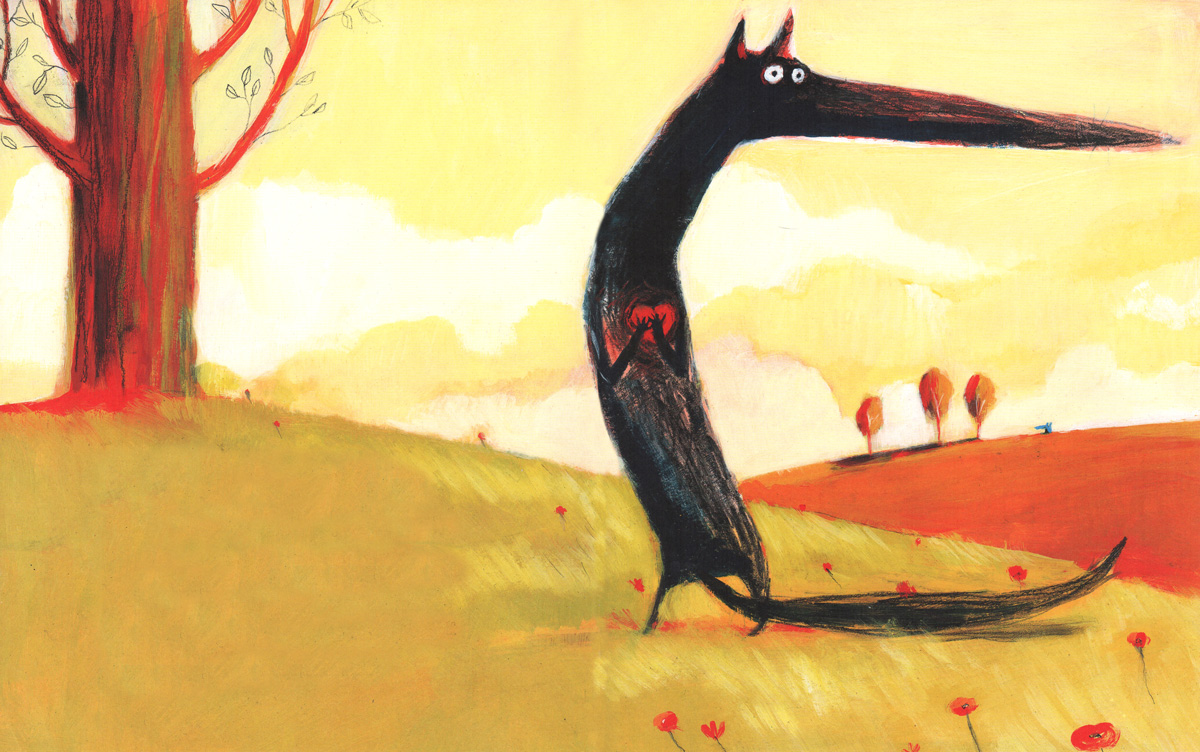
This matters because attention is the lens that renders reality and attention is a function of feeling — by changing our feelings, we change our lens, ultimately changing what we experience as reality:
Feeling… filters out evidence about the self-relevance of what we see, recall, or fantasize… Every emotion does signal the “me” I put into seeing “you.” It signals the often unconscious perspective we apply when we go about seeing. Feeling signals that inner perspective.
In this sense, feeling is an orienteering tool, a clue about where we stand in relation to something or someone. And yet it is prey to one great complication: the interpretation of the clue. Often unconscious, our interpretation of feeling is regularly garbled by what was and by what we think should be — the ghosts of the past and the fantasies of the future haunting the present, warping the present, warping reality itself, effecting what George Eliot called a “double consciousness.” Because to know what is real is the measure of self-trust, confusion and ambivalence about our feelings erode our self-trust.
Unable to bear the internal dissonance, or entirely unaware of it, we cope by feigning to feel something other than what we are actually feeling. Whether performed for others or for the audience of our own confused conscience, this is acting work. Hochschild, who grew up as the child of diplomats, classifies two key varieties — surface acting and deep acting. She writes:
Feelings do not erupt spontaneously or automatically in either deep acting or surface acting. In both cases the actor has learned to intervene — either in creating the inner shape of a feeling or in shaping the outward appearance of one.
[…]
In surface acting we deceive others about what we really feel, but we do not deceive ourselves. Diplomats and actors do this best, and very small children do it worst (it is part of their charm). In deep acting we make feigning easy by making it unnecessary.
We make it unnecessary by replacing our actual feeling with the feeling we wish to project, wish to feel, so that in a sense we no longer need to feign it — we have induced ourselves to feel it. Hochschild, whose study of emotional labor began with hundreds of flight attendants in training, offers an illustrative example:
Can a flight attendant suppress her anger at a passenger who insults her?… She may have lost for awhile the sense of what she would have felt had she not been trying so hard to feel something else. By taking over the levers of feeling production, by pretending deeply, she alters herself.

This alteration of the real self requires tremendous emotional labor, which comes at a great psychological cost — we lose sense of who we are and where we stand. (Those of us who have had to take care of a parent’s emotional needs and feelings from a young age at the expense of feeling our own, at the expense of knowing our own, are particularly vulnerable to such self-abandonment in adult life.)
This notion of deep acting originates in Russian theater pioneer Konstantin Stanislavski’s influential century-old system for training actors in what he called “the art of experiencing” — a practice of tapping into the actor’s conscious thought, will, and memory in order to trigger the unconscious into experiencing, rather than just representing, the emotion the actor must perform in their part.
In one of the many case studies substantiating the book, Hochschild gives the example of a man trying to stop feeling deep love for a woman with whom he is no longer able to have a reciprocal relationship. Applying Stanislavski’s method, the man would draw on his emotional memory to make a list of all the times the woman disappointed him or hurt him, prompting himself to feel the pain and disappointment as an antidote to his love. “He would not, then, fall naturally out of love,” she writes. “He would actively conduct himself out of love through deep acting.”
We are conducting ourselves into and out of feeling all the time as we play the parts of the lives we think we ought to live. Most of the time, we are not even aware we are doing this. We do it especially deftly in love. “I was afraid of being hurt, so I attempted to change my feelings,” an exceptionally self-aware woman tells Hochschild in one of the interviews, naming plainly the commonest contortion of the heart we perform in the pit of fear — after all, falling in love is always and invariably a surrender to the fear of loss. In love, Hochschild observes, one always “wavers between belief and doubt” — and it is precisely when afflicted with ambivalence, when unable to tolereate doubt and reconcile conflicting feelings, that we exert the most toilsome emotional labor.

One of Hochschild’s interview subjects is a woman riven by a common ambivalence — a marriage she has outgrown, yet one in which she continues to stay out of a misplaced feeling of responsibility for her child’s future, forgetting somehow that the greatest gift a parent can give a child is to model the courage of living one’s truth. She tells Hochschild:
I am desperately trying to change my feelings of being trapped [in marriage] into feelings of wanting to remain with my husband voluntarily. Sometimes I think I’m succeeding — sometimes I know I haven’t. It means I have to lie to myself and know I am lying. It means I don’t like myself very much. It also makes me wonder whether or not I’m a bit of a masochist.
Lying to ourselves, Hochschild admonishes, erodes our trust in knowing what is real, what is true. In acting, the actor is aware of the illusion; in life, deluding ourselves is a form of bad faith and self-betrayal, the price of which — paid upon the reluctant but inevitable admission of our inner truth — is a loss of self-respect. She writes:
It is far more unsettling to discover that we have fooled ourselves than to discover that we have been fooling others… When in private life we recognize an illusion we have held, we form a different relation to what we have thought of as our self. We come to distrust our sense of what is true, as we know it through feeling. And if our feelings have lied to us, they cannot be part of our good, trustworthy, “true” self… We may recognize that we distort reality, that we deny or suppress truths, but we rely on an observing ego to comment on these unconscious processes in us and to try to find out what is going on despite them.
Hochschild offers a single, merciless antidote to this all too human tendency toward self-delusion: “constant attention, continual questioning and testing” of what we believe about ourselves, what we trust in ourselves. Then and only then can we begin to treat our hearts not as something to be managed but as something to be met, discovering in that meeting the truth of who we are.
Couple The Managed Heart with Javier Marías on the courage to heed your intuitions, then revisit the fascinating science of how emotions are made.
donating = loving
For seventeen years, I have been spending hundreds of hours and thousands of dollars each month composing The Marginalian (which bore the outgrown name Brain Pickings for its first fifteen years). It has remained free and ad-free and alive thanks to patronage from readers. I have no staff, no interns, no assistant — a thoroughly one-woman labor of love that is also my life and my livelihood. If this labor makes your own life more livable in any way, please consider lending a helping hand with a donation. Your support makes all the difference.
newsletter
The Marginalian has a free weekly newsletter. It comes out on Sundays and offers the week’s most inspiring reading. Here’s what to expect. Like? Sign up.
Source: The Marginalian | 15 Nov 2024 | 4:29 am(NZT)
Louise Erdrich on the Deepest Meaning of Resistance
“Resist loss of the miraculous by lowering your standards for what constitutes a miracle. It is all a fucking miracle.”
The best advice we have for anyone else is always advice to ourselves, honed on the sincerity of living, learned through life’s best teaching tool: suffering. Otherwise it becomes that most untrustworthy of transmissions: preaching. It is in speaking to ourselves that we practice speaking the truth — the unflattering truth, the incongruous truth, the truth trembling with all the terror and tenderness of knowing ourselves in order to know the world, of loving ourselves in order to love the world.
That is what Native American novelist, poet, and children’s book author Louise Erdrich — she who urged us so passionately to love anyway — offers in “Advice to Myself #2: Resistance,” originally published in a special edition of Orion Magazine — a poem evocative of Derek Walcott’s classic “Love After Love,” of Leonard Cohen’s lyric reckoning with resistance, and yet entirely original for the simple reason of drawing from the freshest spring of the universal: the most deeply personal.
ADVICE TO MYSELF #2: RESISTANCE
by Louise ErdrichResist the thought that you may need a savior,
or another special being to walk beside you.
Resist the thought that you are alone.
Resist turning your back on the knife
of the world’s sorrow,
resist turning that knife upon yourself.
Resist your disappearance
into sentimental monikers,
into the violent pattern of corporate logos,
into the mouth of the unholy flower of consumerism.
Resist being consumed.
Resist your disappearance
into anything except
the face you had before you walked up to the podium.
Resist all funding sources but accept all money.
Cut the strings and dismantle the web
that needing money throws over you.
Resist the distractions of excess.
Wear old clothes and avoid chain restaurants.
Resist your genius and your own significance
as declared by others.
Resist all hint of glory but accept the accolade
as tributes to your double.
Walk away in your unpurchased skin.
Resist the millionth purchase and go backward.
Get rid of everything.
If you exist, then you are loved
by existence. What do you need?
A spoon, a blanket, a bowl, a book —
maybe the book you give away.
Resist the need to worry, robbing everything
of immediacy and peace.
Resist traveling except where you want to go.
Resist seeing yourself in others or them in you.
Nothing, everything, is personal.
Resist all pressure to have children
unless you crave the torment of joy.
If you give in to irrationality, then
resist cleaning up the messes your children make.
You are robbing them of small despairs they can fix.
Resist cleaning up after your husband.
It will soon replace having sex with him.
Resist outrageous charts spelling doom.
However you can, rely on sun and wind.
Resist loss of the miraculous
by lowering your standards
for what constitutes a miracle.
It is all a fucking miracle.
Resist your own gift’s power
to tear you away from the simplicity of tears.
Your gift will begin to watch you having your emotions,
so that it can use them in an interesting paragraph,
or to get a laugh.
Resist the blue chair of dreams, the red chair of science, the black chair of the humanities, and just be human.
Resist all chairs.
Be the one sitting on the ground
or perching on the beam overhead
or sleeping beneath the podium.
Resist disappearing from the stage,
unless you can walk straight into the bathroom and resume the face,
the desolate face, the radiant face, the weary face, the face
that has become your own, though all your life
you have resisted it.
Couple with e.e. cummings on the courage to be yourself — the ultimate act of resistance “in a world which is doing its best, night and day, to make you everybody else” — then revisit Grace Paley on the art of growing older, predicated on how you hold your face.
donating = loving
For seventeen years, I have been spending hundreds of hours and thousands of dollars each month composing The Marginalian (which bore the outgrown name Brain Pickings for its first fifteen years). It has remained free and ad-free and alive thanks to patronage from readers. I have no staff, no interns, no assistant — a thoroughly one-woman labor of love that is also my life and my livelihood. If this labor makes your own life more livable in any way, please consider lending a helping hand with a donation. Your support makes all the difference.
newsletter
The Marginalian has a free weekly newsletter. It comes out on Sundays and offers the week’s most inspiring reading. Here’s what to expect. Like? Sign up.
Source: The Marginalian | 14 Nov 2024 | 7:06 am(NZT)
Prisons We Choose to Live Inside: Doris Lessing on Redeeming Humanity

This is the history of the world: revolutionaries turning into tyrants, leaders who claim to stand with the masses turning the individuals within them on each other, stirring certainties and self-righteousness to distract from the uncomfortable unknowns, from the great open question of what makes us and keeps us human, and human together.
This is also the history of the world: artists — those lighthouses of the spirit — speaking truth to power, placing imagination ahead of ideology, the soul above the self, unselfing us into seeing each other, into remembering, as James Baldwin told Margaret Mead in their epochal conversation, that “we are still each other’s only hope.”
Born in Iran months after the end of the First World War and raised by farming parents in present-day Zimbabwe, Doris Lessing (October 22, 1919–November 17, 2013) was still a girl when she sensed something deeply wrong with the unquestioned colonial system of her world, with the oppression that was the axis of that world. By the time she was a young woman — a time when our urge to rebel against the broken system is fiery but we don’t yet have the tools to rebel intelligently, don’t yet know the right questions to ask in order to tell whether the answer we are holding up as an alternative is any better or worse — she rebelled by embracing Communism as “an interesting manifestation of popular will.” Working by that point as a telephone operator in England, she joined the Communist Party. “It was a conversion, apparently sudden, and total (though short-lived),” she would later recall. “Communism was in fact a germ or virus that had already been at work in me for a long time… because of my rejection of the repressive and unjust society of old white-dominated Africa.” It didn’t take her long to see the cracks in Communism. She left the party, discovered Sufism, grew fascinated with the nascent field of behavioral psychology and its revelatory, often disquieting findings about the inner workings of the mind, of its formidable powers to act and its immense vulnerabilities to being acted upon. But she found no ready-made answer to the problem of social harmony.

And so, in that way artists have of complaining by creating, she devoted her life — almost a century of life, a century of world wars and violent uprisings, of changes unimaginable to her parents — to asking the difficult, clarifying questions that help us better understand what makes us human, how we allow ourselves to dehumanize others, and what it takes to cohere, as individuals and as societies. At 87, she became the oldest person to receive the Nobel Prize, awarded her for writing that “with scepticism, fire and visionary power has subjected a divided civilisation to scrutiny.”
In 1985, months after I was born under Bulgaria’s Communist dictatorship, Doris Lessing delivered Canada’s esteemed annual Massey Lectures, later adapted into a series of short essays under the haunting title Prisons We Choose to Live Inside (public library) — a searching look at how it is that “we (the human race) are now in possession of a great deal of hard information about ourselves, but we do not use it to improve our institutions and therefore our lives,” lensed through a lucid faith that we have all the power, urgency, and dignity we need to choose otherwise, to use what we have learned about the worst of our nature to nurture and magnify the best of our nature, to figure out “how we behave so that we control the society and the society does not control us.”

In a sentiment Rebecca Solnit would echo three decades later in her modern classic Hope in the Dark, Lessing writes:
This is a time when it is frightening to be alive, when it is hard to think of human beings as rational creatures. Everywhere we look we see brutality, stupidity, until it seems that there is nothing else to be seen but that — a descent into barbarism, everywhere, which we are unable to check. But I think that while it is true there is a general worsening, it is precisely because things are so frightening we become hypnotized, and do not notice — or if we notice, belittle — equally strong forces on the other side, the forces, in short, of reason, sanity and civilization.
To be realistic about our own nature, Lessing argues, requires attentiveness to both of these strands — the destructive and the creative. This is the cosmic mirror Maya Angelou held up to humanity in her stunning space-bound poem, urging us to “learn that we are neither devils nor divines.” An epoch before her, Bertrand Russell — also a Nobel laureate in Literature, though trained as a scientist — reckoned with our twin capacities to define them in elemental terms — “We construct when we increase the potential energy of the system in which we are interested, and we destroy when we diminish the potential energy.” — and in existential terms: “Construction and destruction alike satisfy the will to power, but construction is more difficult as a rule, and therefore gives more satisfaction to the person who can achieve it.”
Our sanity, Lessing observes, lies in “our capacity to be detached and unflattering about ourselves” — and in the understanding that our selves are not islanded in time but lineages of beliefs and tendencies with roots much longer than our lifetimes, not sovereign but contiguous with all the other selves that occupy the particular patch of spacetime we have been born into. It is vital, she insists, that we examine ourselves — our selves, and the constellation of selves that is our given society — from various elsewheres.

This is why we need writers — those professional observers, in Susan Sontag’s splendid definition, whose job it is to “pay attention to the world” and shine the light of that attention on every side of the kaleidoscope that is a given culture at a given time. A decade after Iris Murdoch wrote in her superb reckoning with the role of literature in democracy that “tyrants always fear art because tyrants want to mystify while art tends to clarify,” Lessing writes:
In totalitarian societies writers are distrusted for precisely this reason… Writers everywhere are aspects of each other, aspects of a function that has been evolved by society… Literature is one of the most useful ways we have of achieving this “other eye,” this detached manner of seeing ourselves; history is another.
Because we are the future of our own past, the posterity of our ancestors, looking back on history from our present vantage point offers fertile training ground for looking forward, for shaping the world of tomorrow. Lessing writes:
Anyone who reads history at all knows that the passionate and powerful convictions of one century usually seem absurd, extraordinary, to the next. There is no epoch in history that seems to us as it must have to the people who lived through it. What we live through, in any age, is the effect on us of mass emotions and of social conditions from which it is almost impossible to detach ourselves.
[…]
There is no such thing as my being in the right, my side being in the right, because within a generation or two, my present way of thinking is bound to be found perhaps faintly ludicrous, perhaps quite outmoded by new development — at the best, something that has been changed, all passion spent, into a small part of a great process, a development.

In consonance with Carl Sagan’s admonition against “the sense that we have a monopoly on the truth” and with Joan Didion’s admonition against mistaking self-righteousness for morality, Lessing offers:
This business of seeing ourselves as in the right, others in the wrong; our cause as right, theirs as wrong; our ideas as correct, theirs as nonsense, if not as downright evil… Well, in our sober moments, our human moments, the times when we think, reflect, and allow our rational minds to dominate us, we all of us suspect that this “I am right, you are wrong” is, quite simply, nonsense. All history, development goes on through interaction and mutual influence, and even the most violent extremes of thought, of behaviour, become woven into the general texture of human life, as one strand of it. This process can be seen over and over again in history. In fact, it is as if what is real in human development — the main current of social evolution — cannot tolerate extremes, so it seeks to expel extremes and extremists, or to get rid of them by absorbing them into the general stream.
Looking back on the colonialist Zimbabwe of her childhood, on the “prejudiced, ugly, ignorant” attitudes of the ruling whites, she reflects:
These attitudes were assumed to be unchallengeable and unalterable, though the merest glance at history would have told them (and many of them were educated people) that it was inevitable their rule would pass, that their certitudes were temporary.
At the center of Lessing’s inquiry is the paradox of how seemingly sound-minded, kind-hearted people get enlisted in ideologies of oppression. Kierkegaard had written in the Golden Age of European revolutions — those idealistic but imperfect attempts to unify fractured feudal duchies into free nations, attempts that modeled the possibility of a United States of America — that “the evolution of the world tends to show the absolute importance of the category of the individual apart from the crowd,” that “truth always rests with the minority, and the minority is always stronger than the majority, because… the strength of a majority is illusory, formed by the gangs who have no opinion.” An epoch and a world order later, Lessing considers how regimes of terror take hold:
Nearly everyone in such situations behaves automatically. But there is always the minority who do not, and it seems to me that our future, the future of everybody, depends on this minority. And that we should be thinking of ways to educate our children to strengthen this minority and not, as we mostly do now, to revere the pack.

The mess we have made, she intimates, may be the most effective teaching tool we have — a living admonition against doing the same, a clarion call to rebel by doing otherwise:
Perhaps it is not too much to say that in these violent times the kindest, wisest wish we have for the young must be: “We hope that your period of immersion in group lunacy, group self-righteousness, will not coincide with some period of your country’s history when you can put your murderous and stupid ideas into practice. “If you are lucky, you will emerge much enlarged by your experience of what you are capable of in the way of bigotry and intolerance. You will understand absolutely how sane people, in periods of public insanity, can murder, destroy, lie, swear black is white.”
As for us, here in the roiling mess, our sole salvation lies in learning to “live our lives with minds free of violent and passionate commitment, but in a condition of intelligent doubt about ourselves and our lives, a state of quiet, tentative, dispassionate curiosity.” Lessing writes:
While all these boilings and upheavals go on, at the same time, parallel, continues this other revolution: the quiet revolution, based on sober and accurate observation of ourselves, our behaviour, our capacities… If we decided to use it, [we may] transform the world we live in. But it means making that deliberate step into objectivity and away from wild emotionalism, deliberately choosing to see ourselves as, perhaps, a visitor from another planet might see us.

This, in fact, was the conditional clause in Baldwin’s words to Mead — in order to be “each other’s only hope,” he said, we ought to be “as clear-headed about human beings as possible.” This, too, was Maya Angelou’s conditional optimism for humanity: “That is when, and only when, we come to it” — to that “Brave and Startling Truth,” balanced on the fulcrum of our conflicted capacities, “that we are the possible, we are the miraculous, the true wonder of this world.”
donating = loving
For seventeen years, I have been spending hundreds of hours and thousands of dollars each month composing The Marginalian (which bore the outgrown name Brain Pickings for its first fifteen years). It has remained free and ad-free and alive thanks to patronage from readers. I have no staff, no interns, no assistant — a thoroughly one-woman labor of love that is also my life and my livelihood. If this labor makes your own life more livable in any way, please consider lending a helping hand with a donation. Your support makes all the difference.
newsletter
The Marginalian has a free weekly newsletter. It comes out on Sundays and offers the week’s most inspiring reading. Here’s what to expect. Like? Sign up.
Source: The Marginalian | 12 Nov 2024 | 8:49 am(NZT)
Oliver Sacks on Despair and the Meaning of Life
“The meaning of life… clearly has to do with love — what and whom and how one can love.”

Meaning is not something we find — it is something we make, and the puzzle pieces are often the fragments of our shattered hopes and dreams. “There is no love of life without despair of life,” Albert Camus wrote between two World Wars. The transmutation of despair into love is what we call meaning. It is an active, searching process — a creative act. Paradoxically, we make meaning most readily, most urgently, in times of confusion and despair, when life as we know it has ceased to make sense and we must derive for ourselves not only what makes it livable but what makes it worth living. Those are clarifying times, sanctifying times, when the simulacra of meaning we have consciously and unconsciously borrowed from our culture — God and money, the family unit and perfect teeth — fall away to reveal the naked soul of being, to hone the spirit on the mortal bone.
The poetic neurologist Oliver Sacks (July 9, 1933–August 30, 2015) — who thought with uncommon rigor and compassion about what it means to be human and all the different ways of being and remaining human no matter how our minds may fray — takes up this question of life’s meaning in one of his magnificent collected Letters (public library).

In his fifty-seventh year, Sacks reached out to the philosopher Hugh S. Moorhead in response to his anthology of reflections on the meaning of life by some of the twentieth century’s greatest writers and thinkers. (Three years later, LIFE magazine would plagiarize Moorhead’s concept in an anthology of their own, even taking the same title.) Sacks — a self-described “sort of atheist (curious, sometimes wistful, often indifferent, never militant)” — offers his own perspective:
I envy those who are able to find meanings — above all, ultimate meanings — from cultural and religious structures. And, in this sense, to “believe” and “belong.”
[…]
I do not find, for myself, that any steady sense of “meaning” can be provided by any cultural institution, or any religion, or any philosophy, or (what might be called) a dully “materialistic” Science. I am excited by a different vision of Science, which sees the emergence and making of order as the “center” of the universe.
It is in this 1990 letter that Sacks began germinating the seeds of the personal credo that would come abloom in his poignant deathbed reflection on the measure of living and the dignity of dying thirty-five years later. He tells Moorhead:
I do not (at least consciously) have a steady sense of life’s meaning. I keep losing it, and having to re-achieve it, again and again. I can only re-achieve (or “remember”) it when I am “inspired” by things or events or people, when I get a sense of the immense intricacy and mystery, but also the deep ordering positivity, of Nature and History.
I do not believe in, never have believed in, any “transcendental” spirit above Nature; but there is a spirit in Nature, a cosmogenic spirit, which commands my respect and love; and it is this, perhaps most deeply, which serves to “explain” life, give it “meaning.”
Nine years later, in a different letter to Stephen Jay Gould, he would take issue with the idea that there are two “magisteria” — two different realms of reality, one natural and one supernatural — writing:
Talk of “parapsychology” and astrology and ghosts and spirits infuriates me, with their implication of “another,” as-it-were parallel world. But when I read poetry, or listen to Mozart, or see selfless acts, I do, of course feel a “higher” domain (but one which Nature reaches up to, not separate in nature).

A century and a half earlier, his beloved Darwin had articulated a similar sentiment in contemplating the spirituality of nature after docking the Beagle in Chile, as had Whitman in contemplating the meaning of life in the wake of a paralytic stroke — exactly the kind of physiological and neurological disordering Sacks studied with such passion and compassion for what keeps despair at bay, what keeps life meaningful, when the mind — that meeting place of the body and the spirit — comes undone. At the heart of his letter to Moorhead is the recognition that there is something wider than thought, deeper than belief, that animates our lives:
When moods of defeat, despair, accidie and “So-what-ness” visit me (they are not infrequent!), I find a sense of hope and meaning in my patients, who do not give up despite devastating disease. If they who are so ill, so without the usual strengths and supports and hopes, if they can be affirmative — there must be something to affirm, and an inextinguishable power of affirmation within us.
I think “the meaning of life” is something we have to formulate for ourselves, we have to determine what has meaning for us… It clearly has to do with love — what and whom and how one can love.

As if to remind us that the capacity for love may be the crowning achievement of consciousness, which is itself the crowning achievement of the universe, which means that we may only be here to learn how to love, he adds:
I do not think that love is “just an emotion,” but that it is constitutive in our whole mental structure (and, therefore, in the development of our brains).
Complement this small fragment of Oliver Sacks’s wide and wonderful Letters with Rachel Carson on the meaning of life, Loren Eiseley on its first and final truth, and Mary Shelley — having lost her mother at birth, having lost three of her own children, her only sister, and the love of her life before the end of her twenties — on what makes life worth living, then revisit Oliver Sacks (writing 30 years before ChatGPT) on consciousness, AI, and our search for meaning and his timely long-ago reflection on how to save humanity from itself.
donating = loving
For seventeen years, I have been spending hundreds of hours and thousands of dollars each month composing The Marginalian (which bore the outgrown name Brain Pickings for its first fifteen years). It has remained free and ad-free and alive thanks to patronage from readers. I have no staff, no interns, no assistant — a thoroughly one-woman labor of love that is also my life and my livelihood. If this labor makes your own life more livable in any way, please consider lending a helping hand with a donation. Your support makes all the difference.
newsletter
The Marginalian has a free weekly newsletter. It comes out on Sundays and offers the week’s most inspiring reading. Here’s what to expect. Like? Sign up.
Source: The Marginalian | 9 Nov 2024 | 6:29 am(NZT)